What are you looking for?

When selecting a chromatography column, understanding the precise chemical makeup of the stationary phase is critical for achieving optimal separation and analysis results. If you’re confused about whether an Octadecylsilyl silica gel column refers to a C18 or C8 column, this guide will clear up the confusion.
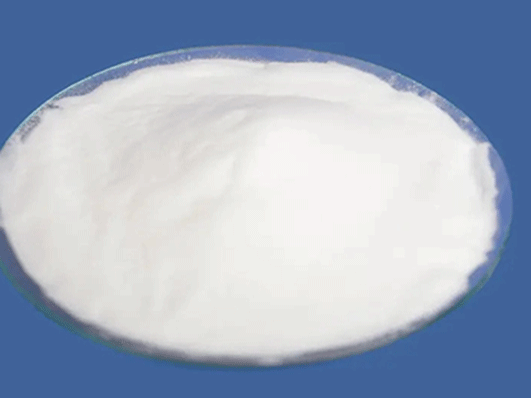
An Octadecylsilyl (ODS) silica gel column is synonymous with a C18 column. The term "Octadecyl" (C18H37) refers to the functional group made up of an 18-carbon alkyl chain bonded to silica gel particles. This makes ODS columns the most commonly used stationary phases in Reversed-Phase High-Performance Liquid Chromatography (RP-HPLC) due to their exceptional hydrophobicity and versatility.
Chromatography columns used in reversed-phase separations rely on the interaction between the stationary phase and the analytes in the sample. The chemical structure of the stationary phase plays a critical role in determining the selectivity and separation efficiency of the column.
In an ODS silica gel column, octadecylsilyl groups (C18H37) are covalently bonded to the surface of high-purity silica. This bonding is achieved via silanization, where reactive silanol (-Si-OH) groups on the silica surface are modified with octadecylsilane reagents. The result is a hydrophobic stationary phase that interacts strongly with non-polar compounds.
The key functional group of a C18 column is the octadecyl group:
C18H37-Si-O-Si-(Silica framework)
This long hydrocarbon chain provides significant hydrophobic surface area, making C18 columns ideal for separating non-polar or moderately polar compounds.
High Retention for Non-Polar Molecules: The 18-carbon chain length ensures strong hydrophobic interactions with analytes, yielding better separation of large, non-polar molecules like lipids, fatty acids, and vitamins.
Versatile Applications: From pharmaceuticals to environmental testing, the C18 column is adaptable to a broad range of industries.
Consistent Performance: The uniform bonding of octadecyl groups on high-purity silica ensures reproducible results across analyses.
While both C18 (Octadecylsilyl) and C8 (Octylsilyl) columns are common in reversed-phase chromatography, they offer significantly different performance characteristics due to the variation in carbon chain length. Here’s a side-by-side comparison:
| Feature | C18 (Octadecylsilyl) | C8 (Octylsilyl) |
| Carbon Chain Length | 18 carbons | 8 carbons |
| Hydrophobicity | High (Stronger retention) | Moderate (Faster elution) |
| Polarity | Less polar | Slightly more polar |
| Common Applications | Long-chain fatty acids, vitamins, lipids | Proteins, small peptides |
| Analysis Time | Longer (stronger analyte retention) | Shorter (weaker analyte retention) |
Opt for C18: When analyzing highly hydrophobic, long-chain compounds like fatty acids or lipid-based drugs.
Opt for C8: When working with moderately hydrophobic compounds, shorter retention times, or when there’s a specific need to minimize column binding for faster elution.
The versatility of C18 (ODS) columns makes them indispensable across multiple industries. Below are some of their most common applications:
ODS columns are widely used to analyze drug purity, stability, and impurity profiling. Examples include:
Quantifying pharmaceutical actives.
Separating drug metabolites in biological samples.
C18 columns are ideal for detecting hydrophobic pollutants, such as:
Pesticides and herbicides in water.
Organic contaminants in soil or wastewater.
Food chemists rely on ODS silica gel columns to ensure product safety and consistency, including:
Measuring preservatives and artificial additives.
Analyzing natural substances like vitamins and polyphenols.
Delivering scientifically accurate and precise chromatography results requires attention to critical factors that influence column performance:
The density of C18 chains on the silica determines the strength of hydrophobic interactions. Higher carbon loading typically increases analyte retention, ensuring better resolution for non-polar substances.
Residual silanol groups (-Si-OH) on the silica surface can interact with polar analytes, leading to peak tailing. End-capped ODS columns, where these silanol groups are deactivated, often improve performance by reducing secondary interactions and ensuring symmetrical peaks.
Pore Size: Standard C18 columns feature 100Å pore silica, suitable for analytes with molecular weights below 3,000 Da. Larger pore sizes may be required for separating proteins or other large biomolecules.
Particle Size: Smaller particle sizes (e.g., 3µm or 5µm) provide higher resolution but may require greater system pressure.
Extending the lifespan of your ODS column not only optimizes performance but also reduces costs. Here’s how to maintain your column effectively:
Use Proper pH Ranges: Avoid exceeding the recommended pH range (commonly 2.0 to 8.0 for silica-based columns) to prevent damage to the stationary phase.
Flush with Appropriate Storage Solvents: Store C18 columns in a mixture of acetonitrile and water to maintain the integrity of the stationary phase.
Avoid Contaminants: Use high-purity column chromatography silica gel and ensure all solvents are HPLC-grade to prevent particulate or metal contamination.
A: ODS stands for Octadecylsilyl, a functional group with an 18-carbon chain chemically bonded to silica gel.
A: C18 columns are preferred for analyzing highly hydrophobic compounds and when stronger retention or higher resolution is needed. C8 columns are better suited for shorter retention times and smaller hydrophobic molecules.
A: While ODS columns are optimized for non-polar to moderately polar compounds, their retention for highly polar compounds may be limited without modifications to the mobile phase.
An Octadecylsilyl silica gel column (C18) is the gold standard in RP-HPLC due to its exceptional hydrophobicity, broad application range, and robust performance. Understanding its chemistry and how it compares to alternatives like C8 columns allows for better selection tailored to your specific chromatography needs. By considering factors like end-capping, pore size, and carbon loading, you can ensure optimal column performance and longevity.