What are you looking for?

Custom bonded column chromatography silica gel is the engine driving the biotech revolution set to accelerate in 2026. As mRNA-based therapies and oligonucleotide drugs scale up for global distribution, the purification bottleneck looms large. By functionalizing silica surfaces—options include C8, C18, and Ion-Exchange chemistries—manufacturers unlock unparalleled resolution, critical for handling delicate compounds like Lipid Nanoparticles (LNPs) and oligonucleotides. This level of precision ensures the safety, efficacy, and scalability needed by pharmaceutical innovators.
In modern biotech purification, simple or bare silica falls short. LNPs, featuring PEGylated lipids and ionizable compounds, are extremely hydrophobic, while oligonucleotides—antisense therapies, siRNAs—are highly pH-sensitive. Bare silica is prone to excessive silanol activity, causing performance-limiting interactions that distort separation results.
The transition to more sophisticated preparative-scale chromatography tools, such as Preparative HPLC, demands bonded stationary phases tailored to the unique molecular characteristics of these biomolecules. By leveraging functional bonded silica gel, impurities are selectively removed, ensuring pharmaceutical-grade purity of 99%+—a must for drug manufacturing operations.
Pro Tip: Selecting a high-quality column chromatography silica gel is only the first step. The chemistry of the bond dictates separation resolution and operational efficiency.
C8 and C18 bonded phases (Reversed-Phase) have become the gold standard for isolating critical components of LNP formulations: PEGylated lipids and ionizable lipids. These low-polarity compounds demand precise hydrophobicity gradients, which bonded silica delivers through functionalized surfaces engineered for molecular selectivity.
Oligonucleotide separation requires specialized bonding chemistries that balance ion-pairing interactions. Ion-Exchange bonded silica gel provides controlled anion-binding capabilities, ideal for isolating antisense DNA or siRNA molecules at purity levels exceeding 99.5%. Achieving this standard depends on precise carbon loading levels and end-capping processes, both of which reduce unwanted secondary interactions.
For industrial-scale chromatographic operations, spherical silica is non-negotiable. Its uniformity ensures efficient flow rates while minimizing back-pressure even at high throughput. Irregular silica, though cheaper, can compromise scalability due to inconsistent particle size and performance.
Purifying biomolecules like LNPs and oligonucleotides often requires silica gels with optimized pore sizes.
| Pore Size (Å) | Target Molecule |
| 60–100 Å | Small compounds (e.g., excipients) |
| 100–200 Å | Lipids in LNP formulations |
| 300 Å+ | Large peptide complexes |
As a column chromatography silica gel manufacturer, SilicaGelChem customizes pore size distributions to match industrial needs, maximizing loadability while maintaining resolution across batch scales.
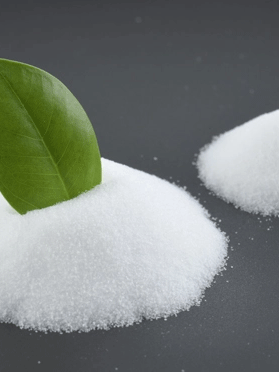
Choosing the right supplier goes beyond basic product specs; it’s about ensuring superior batch-to-batch consistency, regulatory compliance, and the scalability to support long-term drug manufacturing success.
Retention time "drift" can disrupt pharmaceutical production lines, compromising product performance and timelines. Trustworthy manufacturers have rigorous quality control systems that replicate silica’s surface area and bonding chemistry flawlessly across all deliveries.
Uncontrolled trace metals (e.g., Fe, Cr, Ni) in silica gel can leach into the product during purification. Manufacturers using advanced ICP-MS (Inductively Coupled Plasma Mass Spectrometry) guarantee that their materials meet FDA or EMA standards for injectable drugs.
Can your manufacturer maintain the same pore size precision and bonding density when scaling production orders? This scalability is critical as biotech firms move from R&D to commercial production.
Environmental responsibility is non-negotiable in today’s landscape. Chromatography innovations are emphasizing reduced reliance on hazardous solvents and waste minimization through resilient bonding surfaces.
Functionalized silica can adapt to low-toxicity solvents, enabling "green chromatography" practices that reduce environmental impact.
High-density bonding chemistries increase silica’s durability, prolonging its performance lifespan and reducing cost-per-use—an increasingly important factor for biotech companies managing budget-conscious production lines.
Finding the correct particle size is about balancing resolution with operational throughput. Smaller particles (3–5μm) deliver more precise separations but require higher pressure systems, while larger particles (10μm) enable scalable processes with lower back-pressure.
Scaling mRNA therapies and oligonucleotide drugs depends on solving purification bottlenecks, and custom-bonded silica gel is the driving force behind this breakthrough. From LNP lipids to complex oligo formulations, the right stationary phase chemistry optimizes yield, purity, and scalability.